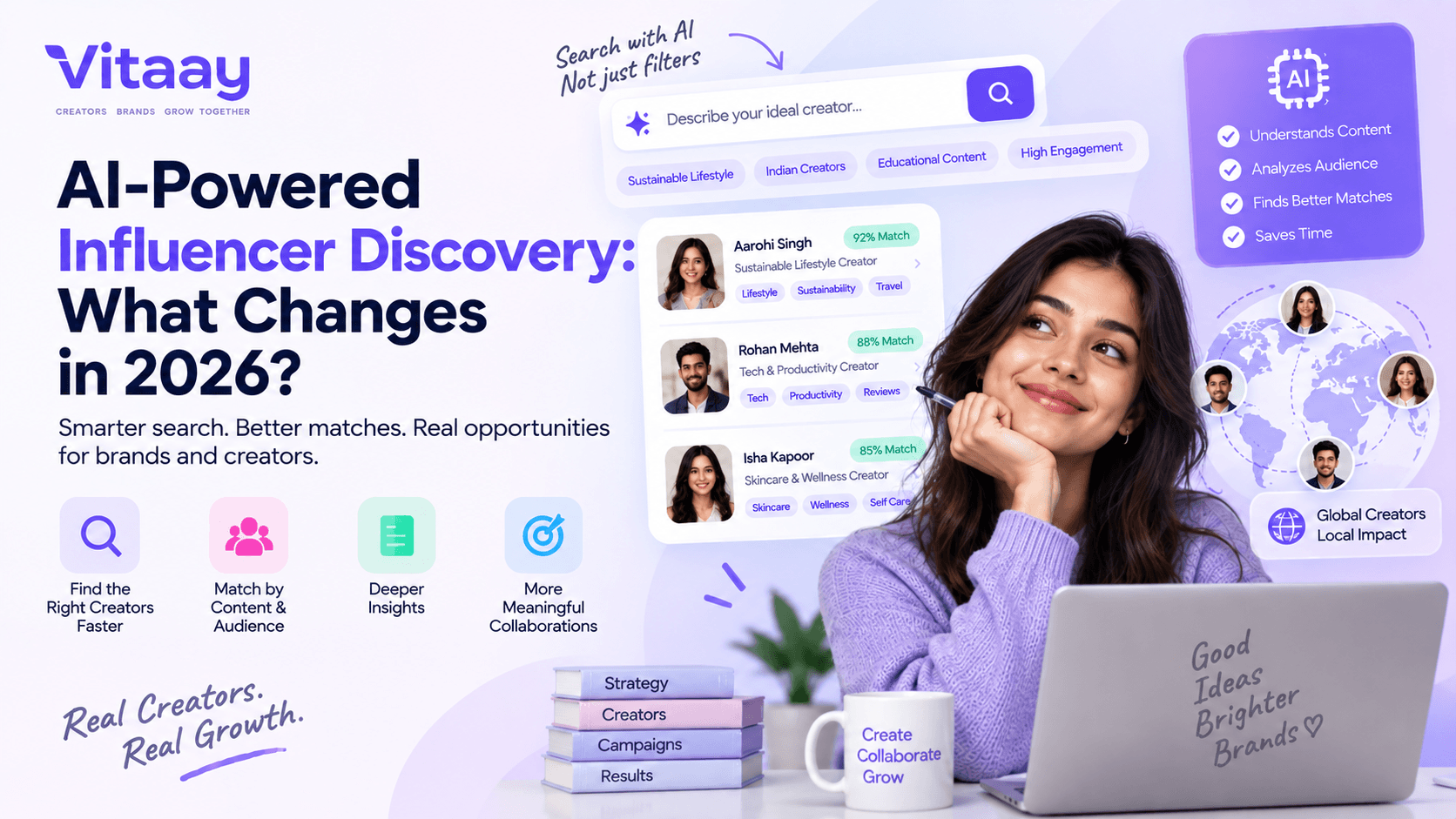
AI-Powered Influencer Discovery: What Changes in 2026?
Finding the right influencer has never been as simple as searching for someone with a large following.
A creator can have an impressive audience and still be a poor fit for a campaign. Their content may not match the brand, their audience may not be relevant, or their communication style may feel unnatural for the product.
This is where AI-powered influencer discovery is changing the process in 2026.
Instead of relying mainly on follower count, categories, location, or basic engagement filters, newer discovery systems can analyze a wider set of signals, including creator content, audience characteristics, topics, engagement patterns, and brand fit.
For marketers, the biggest change is not simply finding creators faster.
It is moving toward finding creators based on why they fit the campaign.
What Is AI-Powered Influencer Discovery?
AI-powered influencer discovery uses artificial intelligence to help brands identify creators who may be suitable for a particular campaign.
Traditional discovery usually starts with filters.
A marketer might search for:
Beauty creators 50,000 to 500,000 followers Based in India Instagram creators A specific engagement range
AI can add another layer to this process.
Instead of only asking for a category, a marketer can describe what the campaign actually needs. The system can then analyze creator data and content to identify potential matches.
For example, a skincare brand may not simply want "beauty influencers."
It may want creators who regularly discuss sensitive skin, explain skincare routines in an educational way, and have an audience interested in skincare rather than general lifestyle content.
That difference is important.
The search moves from who fits a filter to who fits the campaign.
Why Influencer Discovery Is Changing in 2026
The creator economy has become more complex.
Brands now work with creators across different platforms, audience sizes, niches, languages, and content formats. A manual search can therefore involve reviewing hundreds of profiles before reaching a useful shortlist.
AI is being introduced to reduce some of this repetitive work.
Current creator-discovery products are already using AI for semantic or topical search, creator matching, audience analysis, authenticity checks, and recommendation systems. For example, Sprout Social's AI-assisted topical search focuses on what creators actually discuss rather than relying only on traditional keyword or demographic searches.
Other newer platforms are combining AI discovery with audience signals, authenticity verification, performance analytics, and lookalike creator expansion.
The result is a discovery process that can potentially move from broad searching to more contextual recommendations.
- Search Is Moving Beyond Follower Count
Follower count is easy to understand.
But it does not tell a brand everything it needs to know.
A creator with 500,000 followers may not be as relevant to a campaign as a creator with 50,000 highly relevant followers.
AI-powered discovery can consider additional signals alongside audience size.
These may include:
Content topics Audience demographics Engagement patterns Creator niche Previous content Brand relevance Audience interests Location Platform Creator performance
This does not make follower count useless.
It simply makes it one signal among many.
What brands should do
When evaluating an AI discovery platform, check whether you can understand the reasons behind its recommendations.
A useful recommendation should give marketers enough context to answer:
Why does this creator fit my campaign?
- Content Context Is Becoming More Important
One of the most useful changes is the ability to search based on content context.
Traditional keyword search can be limited.
Imagine a brand searches for "fitness creator."
That could return creators who post about workouts, nutrition, running, gym fashion, sports, wellness, or even motivational content.
AI-powered semantic search can potentially understand the difference between these topics.
Sprout Social describes its AI-assisted discovery system as semantic and topic-led, allowing marketers to search for creators based on the subjects they actually discuss.
This matters because creator partnerships work best when the sponsored message makes sense within the creator's existing content.
A running creator discussing running shoes feels natural.
A random lifestyle creator suddenly discussing marathon training may feel forced.
- Creator Matching Is Becoming More Contextual
AI creator matching is another major development.
Instead of simply generating a list of creators, AI systems can compare campaign requirements against creator characteristics.
A campaign might specify:
Target audience Product category Location Language Platform Content style Budget Audience size Campaign objective
The system can then use these requirements to produce a shortlist.
Some newer platforms explicitly describe AI matching systems that combine audience demographics, engagement, content style, authenticity, and other signals.
But brands should be careful with the phrase "perfect match."
No algorithm can completely understand a creator-brand relationship from data alone.
AI should narrow the search.
People should make the final judgment.
- Audience Quality Matters More Than Audience Size
A large audience is not necessarily a valuable audience.
Brands increasingly need to understand whether a creator's audience is actually relevant to the campaign.
AI-powered platforms can help organize audience information such as:
Demographics Interests Location Engagement Audience authenticity Content interaction
This can make creator evaluation more detailed than simply looking at follower counts.
For example, a brand selling a product specifically for young professionals in Mumbai may get better results from a smaller creator whose audience closely matches that group than from a much larger creator with a broad international audience.
The key question becomes:
Who is listening to this creator?
Not just:
How many people follow them?
- AI Can Help With Creator Vetting
Discovery and vetting are closely connected.
Finding a creator is only the first step.
A marketing team still needs to check whether the creator is suitable for the campaign.
AI can help organize information about:
Engagement quality Audience authenticity Content history Brand safety signals Previous collaborations Audience demographics Creator growth patterns
For example, HypeAuditor currently combines AI search with creator analytics, authenticity checks, fraud detection, and audience analysis.
This type of analysis can help teams reduce the amount of manual research involved.
However, automated scores should not be treated as a final answer.
A human should still review the creator's actual content.
- Lookalike Creator Discovery Is Becoming Easier
Sometimes a brand already knows the type of creator it wants.
Instead of starting from scratch, AI can help find creators who resemble an existing successful creator or creator group.
This is known as lookalike discovery.
For example, suppose a brand has previously worked with a creator whose audience and content style were a strong fit.
The team could use that creator as a reference point and search for other creators with similar characteristics.
This can be especially useful when a campaign needs several creators with a consistent audience or content profile.
Some current AI influencer platforms already promote lookalike creator discovery as part of their discovery capabilities.
- Discovery and Outreach Are Becoming Connected
Traditional influencer discovery often looks like this:
Search → Spreadsheet → Copy email → Contact creator → Track response
That creates a lot of manual work.
AI-powered platforms are increasingly connecting discovery with outreach.
A marketer may be able to:
Define a campaign Find suitable creators Review recommendations Create a shortlist Generate personalized outreach Track responses Move selected creators into the campaign workflow
Some platforms now explicitly combine AI creator discovery with personalized outreach and campaign management.
The important benefit is not simply speed.
It is keeping creator information connected throughout the campaign process.
- AI Can Make Creator Research More Scalable
Manual research becomes increasingly difficult as the number of potential creators grows.
A marketer might need to review:
Hundreds of profiles Thousands of posts Different social platforms Audience information Previous collaborations Engagement patterns
AI can help process and organize this information much faster than a person reviewing every profile individually.
That does not mean marketers should stop reviewing creators.
Instead, AI can handle the first layer of research.
The workflow can become:
AI discovery → Human review → Shortlist → Outreach → Collaboration
This is a much more practical use of AI than allowing an algorithm to automatically select every creator.
- Natural-Language Search Can Change How Marketers Work
One of the more interesting developments is natural-language creator search.
Instead of building a complicated filter combination, marketers can describe what they need.
For example:
Find Indian skincare creators who make educational content for young adults and have strong engagement around skincare routines.
A system designed for natural-language search can interpret the campaign description and use it to guide discovery.
This is different from manually selecting dozens of filters.
The marketer explains the problem.
The AI helps translate that requirement into a search.
This type of workflow can make creator discovery more accessible to smaller marketing teams that may not have specialist influencer researchers.
- Human Judgment Is Still Essential
This is probably the most important point.
AI can identify patterns.
It cannot completely understand a creator's personality, relationship with their audience, or whether a partnership will feel authentic.
Consider two creators who both meet the same numerical criteria.
One may produce thoughtful educational content.
The other may promote almost every product they receive.
The numbers could look similar.
The brand fit may not be.
Human review is therefore still necessary.
Marketers should watch recent content, understand the creator's tone, review previous brand partnerships, and consider whether the product would genuinely make sense for the creator's audience.
AI should make this review easier, not eliminate it.
What Changes for Creators?
AI-powered discovery does not only affect brands.
It also changes how creators can think about their profiles.
If discovery systems increasingly analyze content topics and audience relevance, creators should make their niche clear.
A creator should consider:
What subjects do I consistently discuss? Is my content easy to understand? Does my profile clearly communicate my niche? Are my collaborations relevant to my audience? Does my content show what brands can expect from me?
Creators do not need to create content only for algorithms.
The goal is to make their expertise and content identity clear.
That can help both humans and discovery systems understand where the creator fits.
A Practical AI-Powered Influencer Discovery Workflow
Brands can use AI without handing the entire creator-selection process to an algorithm.
Step 1: Define the campaign goal
Decide what the campaign needs to achieve.
This could be awareness, product education, content creation, app promotion, sales support, or another specific objective.
Step 2: Define the ideal audience
Identify the people the campaign needs to reach.
Consider location, interests, age group, language, and relevant communities.
Step 3: Describe the ideal creator
Think beyond follower count.
Define the creator's niche, content style, platform, audience, and communication style.
Step 4: Use AI to generate an initial shortlist
Let the discovery system analyze its available creator data and recommend potential matches.
Step 5: Review the recommendations manually
Check the actual content.
Look for authenticity, quality, relevance, previous collaborations, and brand safety concerns.
Step 6: Compare the strongest candidates
Do not automatically choose the creator with the highest match score.
Compare the reasons behind each recommendation.
Step 7: Start personalized outreach
Contact creators with messages that show an understanding of their content.
Step 8: Record the campaign outcome
Track what happened after the collaboration.
This creates useful information for future creator discovery and campaign planning.
Platforms such as Vitaay can fit into this broader creator-brand discovery process by helping brands and creators find relevant collaboration opportunities. Explore Vitaay.
For businesses interested in discussing creator partnerships or collaboration opportunities, contact Vitaay.