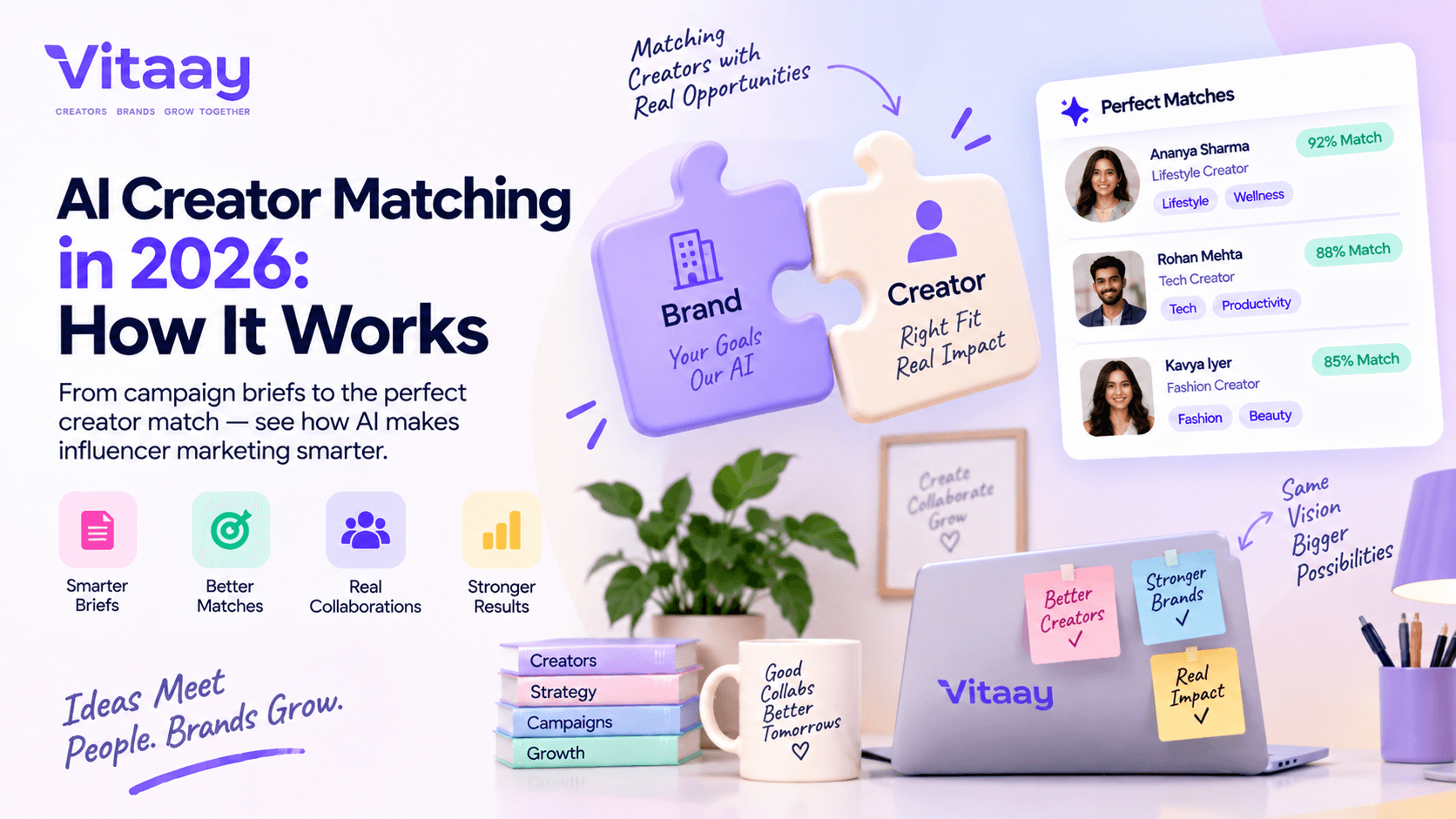
AI Creator Matching in 2026: How It Works
Finding the right creator for a campaign is more complicated than finding someone with a large following.
A creator may have the right audience size but the wrong content style. Another may have fewer followers but a much closer connection with the people a brand wants to reach.
This is why AI creator matching in 2026 is becoming an important part of influencer marketing.
Instead of manually checking hundreds of profiles and creating spreadsheets, AI-powered systems can compare campaign requirements with creator data, content, audience signals, engagement patterns, and other available information.
The goal is not simply to find more creators.
The goal is to find creators who make sense for a particular campaign.
Current AI creator-matching platforms describe systems that can analyze campaign briefs, creator content, audience characteristics, brand requirements, engagement quality, and other signals to generate ranked recommendations.
But there is an important distinction:
AI can recommend a creator. It does not automatically understand every part of a creator-brand relationship.
Human review still matters.
What Is AI Creator Matching?
AI creator matching is the use of artificial intelligence to compare a brand's campaign requirements with available creator information and identify potential matches.
Traditional influencer selection often looks something like this:
Campaign brief → Search creators → Apply filters → Check profiles → Make a shortlist
AI can add another layer:
Campaign brief → AI understands requirements → Analyzes creator signals → Ranks potential matches → Human reviews shortlist
This can reduce repetitive research while giving marketers more information to work with.
For example, a brand launching a fitness product might need creators who:
Speak to fitness-focused audiences Create educational or lifestyle content Reach a specific location Have suitable engagement Work within a particular budget Have a communication style that fits the campaign
An AI matching system can use these requirements to identify creators who appear relevant.
The marketer then decides which creators are actually worth contacting.
Why AI Creator Matching Matters in 2026
The number of creators available to brands continues to make manual discovery difficult.
A marketing team may need to consider creators across several platforms, audience sizes, languages, locations, and content categories.
Looking at each profile individually can take significant time.
AI can help by handling the first stage of comparison.
This is especially useful when the campaign has many requirements.
For example:
Find creators in India who create educational technology content, have an audience interested in productivity and AI tools, and can create short-form videos.
A basic search may struggle with such a request.
A more advanced AI system can interpret the brief and compare several different creator signals.
Platforms currently working in this area describe matching systems that use content, audience, niche, engagement, campaign context, and other information rather than relying only on follower count.
How AI Creator Matching Works
AI creator matching usually involves several stages.
- The Brand Creates a Campaign Brief
Everything starts with the campaign.
The brand needs to explain what it is trying to achieve and who it wants to reach.
A useful brief can include:
Campaign objective Target audience Product or service Preferred social platforms Location Language Creator category Content format Budget Campaign timeline Brand requirements
The clearer the brief, the more useful the matching process can become.
If a brand simply enters "find influencers," there is not enough context to determine what a good match actually means.
- AI Converts the Brief Into Matching Signals
The next step is turning the campaign brief into information that the matching system can compare against creator profiles.
For example, a brief might say:
We need Indian creators who make simple skincare content for young adults and can explain products in an educational but friendly way.
The system may interpret this as a combination of:
Geography Topic Audience Content style Product category Communication style Potential campaign format
Some AI matching systems use natural-language processing and semantic analysis to understand these requirements rather than relying only on exact keywords.
This is one of the biggest differences between traditional filtering and AI-assisted matching.
- AI Analyzes Creator Data
After understanding the campaign, the system compares the requirements with available creator information.
Depending on the platform, this may include:
Creator profile
Basic information such as niche, location, platform, and audience size.
Content
Topics, captions, visual style, themes, and the type of content the creator regularly publishes.
Audience
Available information about audience demographics, interests, geography, and engagement.
Engagement
Signals such as interaction levels and engagement quality.
Brand history
Previous collaborations can sometimes help identify potential conflicts or relevant experience.
Campaign history
Where available, past campaign information can provide additional context about creator performance.
Different platforms use different data sources and matching methods, so marketers should not assume that every AI system evaluates the same signals.
- AI Looks at Creator-Brand Fit
This is where creator matching becomes more useful than a simple creator search.
Suppose two creators both have 100,000 followers.
Creator A mostly creates comedy content.
Creator B creates educational videos about personal finance.
If a financial services brand is launching an educational campaign, Creator B may be a more natural match.
Follower count alone would not explain that difference.
AI matching can consider multiple signals at once.
Some current systems describe matching based on audience overlap, content relevance, brand requirements, creator history, and campaign context.
The idea is to identify fit, not simply size.
- The System Ranks Potential Creators
After comparing creators against the campaign requirements, the system can produce a ranked shortlist.
A simplified example might look like this:
Creator Audience Fit Content Fit Campaign Fit Creator A High High High Creator B High Medium High Creator C Medium High Medium Creator D High Low Medium
The exact scoring method depends on the platform.
Some systems provide a single match score, while others show individual signals or explanations.
For example, Bisket describes AI matching that parses a brand brief into factors such as platform, audience, niche, reach, budget, and brand history before returning a ranked shortlist with reasoning.
The explanation is important.
A marketer should be able to understand why a creator appeared on the shortlist.
- Human Review Comes Before the Final Decision
This is one of the most important steps in AI creator matching.
A high AI score does not automatically mean a creator should be selected.
The marketing team should review:
Recent content Communication style Audience relevance Previous collaborations Brand safety Content quality Creator professionalism Campaign requirements
The human review can also catch things that structured data may miss.
For example, an AI system might identify a creator as highly relevant to a beauty campaign because of their content and audience.
But if the creator has recently moved away from beauty content and now focuses on another niche, the marketer may decide not to proceed.
AI provides the shortlist.
People provide context.
- Outreach Can Follow the Matching Process
Once the shortlist is approved, the next step is usually outreach.
Some platforms are connecting AI matching with creator communication and campaign workflows.
That can create a process such as:
Brief → Match → Review → Outreach → Negotiation → Campaign
Instead of copying creator information from one system into another, the team can continue working from the same campaign record.
This is particularly useful for agencies and brands managing many creator conversations at the same time.
Some current platforms describe AI-assisted outreach and campaign management alongside creator matching.
What Signals Should AI Creator Matching Consider?
There is no single formula that works for every campaign.
However, a useful matching process can consider several categories.
Audience Fit
The creator's audience should make sense for the campaign.
Important factors may include:
Location Age group Interests Language Relevant communities
A large audience that does not match the target customer is not necessarily useful.
Content Fit
The creator should regularly produce content connected to the campaign.
For example, a travel brand may benefit from a creator who regularly discusses travel experiences rather than someone who only occasionally posts about a vacation.
Engagement Quality
Engagement can provide useful context about how audiences interact with a creator.
However, it should not be treated as a complete measure of influence.
AI can help identify patterns, but marketers should still review actual posts and audience interactions.
Brand Fit
The creator's overall communication style should feel appropriate for the brand.
This includes:
Tone Values Visual style Communication approach Previous partnerships
Brand fit is one of the areas where human judgment remains particularly important.
Campaign Fit
The creator should be capable of delivering what the campaign actually requires.
For example:
Short videos Long-form videos Product tutorials Reviews Photos Live content Event coverage
A creator can be highly relevant to the brand but still be unsuitable for a specific campaign format.
AI Matching vs Traditional Influencer Selection
The difference becomes clearer when the two approaches are placed side by side.
Traditional Selection AI Creator Matching Manual profile research Automated initial research Heavy use of filters Multiple matching signals Spreadsheet-based shortlists Ranked recommendations Follower count often dominates Fit can include content and audience Manual comparison AI-assisted comparison Human review Human review still required Often separate outreach process Can connect with campaign workflows
AI does not remove traditional marketing work completely.
It changes where that work happens.
Instead of spending most of the time searching for possible creators, marketers can spend more time reviewing the strongest candidates and building better partnerships.
Can AI Find the Perfect Creator?
No.
This is an important expectation to set.
AI creator matching can make discovery more efficient, but it cannot guarantee that a creator will produce a successful campaign.
A creator recommendation depends on the quality and availability of the underlying data.
There can also be factors that are difficult to measure.
For example:
How comfortable the creator is with the product How naturally they communicate the message Whether their audience trusts their recommendations How well they work with the brand team Whether the creative idea feels authentic
These factors can become clear only through human review and collaboration.
Some newer platforms are explicitly combining AI matching with human review for this reason. Bioby.ai, for example, describes an approach that combines AI matching with human quality control rather than fully delegating creator selection to automation.